DC Two: Data Centre Portal & Platform Development
Built and led development of the DC Portal client platform — CMS, SPLA billing and the PDU/pod telemetry dashboards — growing from sole front-end developer into second of two technical leads.
This case study covers the platform build. For the brand system, marketing collateral and the ASX listing’s communications workstream, see DC Two: Brand System, Marketing & the ASX Listing.
The Growth Arc
I joined DC Two as the sole front-end developer and UI designer at a then-small company, working under the lead architect/developer. He mentored me into full-stack development (back-end, databases, the full toolchain) and together we built the platform from the ground up. Within the first year, I grew into second of two technical leads on the software and codebase, with the architect leading, as the team grew to 4 developers.
This is how a designer came to own production code: not through a bootcamp or a career change, but through building an entire platform from scratch alongside a senior engineer who invested in the transition. That learning curve developed over five years of deep, daily experience on the tools, not a quick ramp.
The DC Portal
The DC Portal was a comprehensive CMS and client portal for cloud hosting management, SPLA software auditing and automated end-of-month billing across hundreds of clients and resellers. It included account management, container detail views, product pricing, responsive layouts, and the SAM (Site Administration and Management) tool for daily and monthly operational summaries. This was the core platform I helped build and maintain over the full tenure.
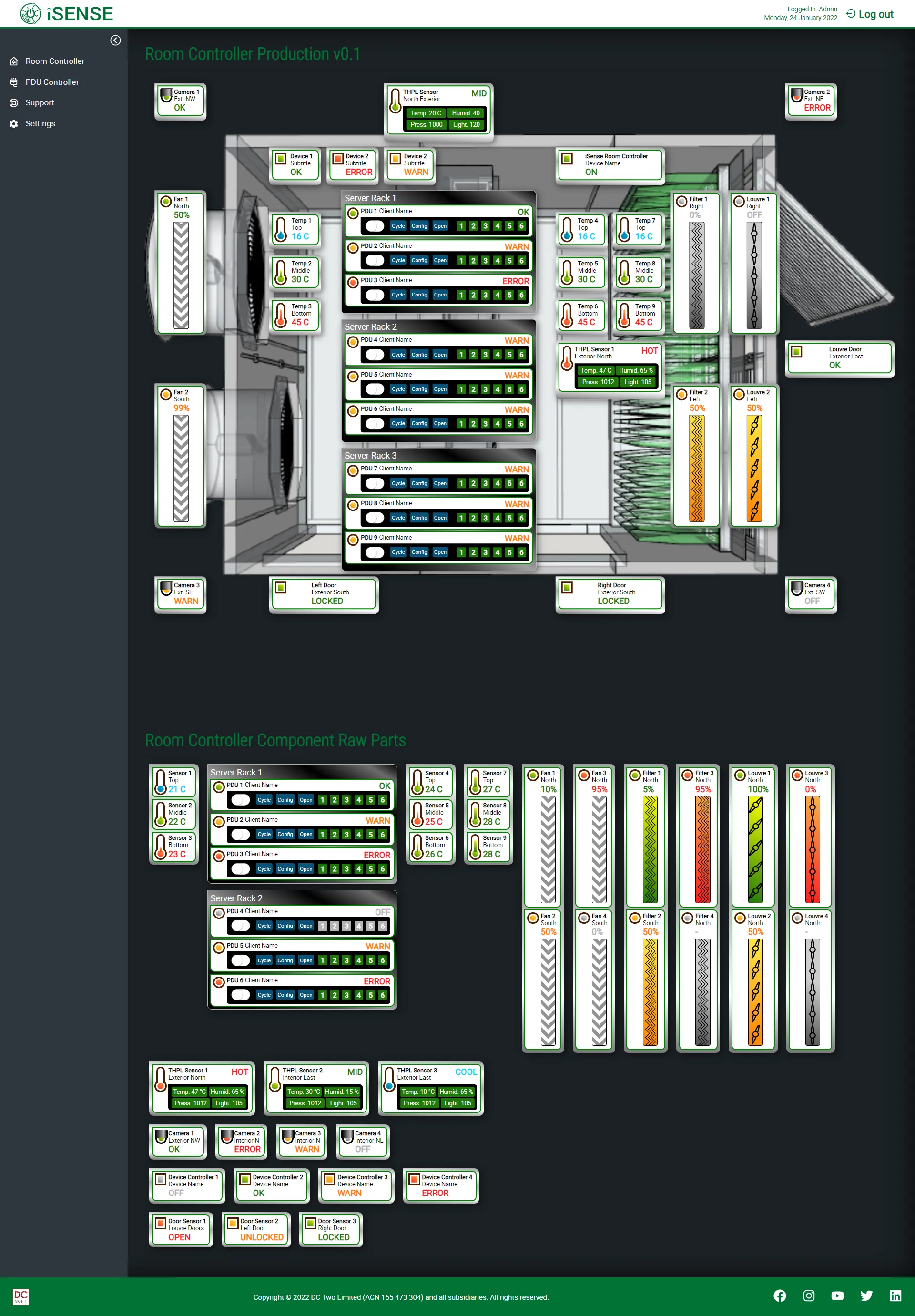
The DC Modular work developed in two distinct versions. V1 was a production React PDU and device interface, wired to real telemetry and deployed across the metro data centre and remote off-grid modular sites. V2 was the pod data centre dashboard, implemented in React towards the end of my time at DC Two: a complex interactive dashboard with a drag-and-drop floor plan view, responsive widgets, colour indicators and animated states for sensors, fans and device statuses. V2 was proved with real telemetry in development but was not deployed. A physical space rendered as an interactive digital interface. The V2 dashboard was the earliest and clearest precursor to the digital twin work at Insight.
Design Systems, Early
The brand specification behind this platform — a defined type scale, colour tokens with usage rules, logo variant rules — was where design-systems thinking first entered a codebase I was building, years before the Storybook implementations at Capgemini and Insight. The full brand system is its own story; see DC Two: Brand System, Marketing & the ASX Listing.
DC Modular: Renewable-Powered Crypto Hosting
DC Two’s DC Modular line took the same “physical space as digital interface” thinking behind the pod dashboard and applied it to a new product under the DC Two umbrella: containerised data-centre pods deployed “behind the meter” at power generation sites, an Australian first. Initial sites launched at a wind farm in WA’s Mid-West, a solar-connected site in Collie, WA, and a biomass/waste-energy site in Victoria. The pitch was near-source renewable power at competitive rates, aimed squarely at high-density workloads including Bitcoin and cryptocurrency mining.
On the technical side, the DC Portal dashboard was extended to remotely monitor the modular pods’ room controllers and power distribution units, giving DC Two and its customers visibility over infrastructure sitting on a regional wind farm as much as a metro data hall.
DC Two also designed and built a bespoke power distribution unit (PDU) with an in-house IoT telemetry layer. Customer cryptocurrency mining rigs were assigned to ports on the PDU, and I built the portal-side integration: per-rig on/off state, uptime and basic telemetry surfaced per customer, with power draw feeding an automated billing calculation that produced per-machine costs consolidated into a single invoice. The device-side IoT code was owned by another developer. This is the only point in my career where my own work runs the full path from bespoke hardware, through device telemetry, into a customer-facing product, and out as an invoice.
The DC Modular launch brand, sub-brand identity and go-to-market collateral is a separate, non-development body of work — see DC Two: Brand System, Marketing & the ASX Listing.
The Concurrency
From December 2016 to April 2022, this role ran simultaneously with signage, exhibition and museum fabrication at The Factory. For four years (Dec 2016 – Nov 2020, 1–2 days per week at DC Two) I ran cloud and data-centre software development alongside physical space design. This is not a career that moved from physical to digital. Both ran at once. In November 2020, DC Two listed on the ASX, offered me a full-time role, and the Factory work ended. The listing’s marketing and communications workstream — prospectus, investor video, social and SEO — is its own story, covered in DC Two: Brand System, Marketing & the ASX Listing.
Hard Skills
PHP, React, JavaScript, CSS, HTML5, PostgreSQL, Bootstrap, MVC software architecture and design, UML, JIRA, Figma, SketchUp, IoT telemetry integration, automated billing
Soft Skills
Full-stack mentorship and growth, requirements gathering and business analysis, team scaling (2 → 4 developers), systems thinking